
World News
The Rain Man Connection: How a Sister’s Nudge Changed Tom Cruise’s Career Forever
May
A Restaurant, a Sister, and a Serendipitous Meeting
Sometimes, the most significant moments in life are triggered by the smallest nudges. For Tom Cruise, that nudge came from his sister Cass. In the mid-1980s, Cruise was already on a meteoric rise in Hollywood thanks to breakout performances in Risky Business and Top Gun. Despite his fame, Cruise remained grounded in his family ties, and one evening at a restaurant would prove pivotal in shaping the next phase of his career. While dining together, Cass spotted legendary actor Dustin Hoffman seated nearby. Recognizing a rare opportunity, she prodded her younger brother to introduce himself. Cruise hesitated. Approaching a Hollywood titan uninvited was daunting—even for a rising star. But Cass persisted.
Eventually, Cruise walked over to Hoffman, and to his surprise, Hoffman not only recognized him but engaged warmly. Their brief interaction led to an invitation to watch Hoffman perform in Death of a Salesman. The meeting continued backstage, where a memorable comment was made: “You and I are going to make a movie together one day,” Hoffman said with conviction. Cruise was flattered but had no inkling that this casual promise would soon become a career-defining moment. That serendipitous meeting set the stage for one of the most iconic films of the 1980s—and began a collaboration that would influence Cruise’s acting path forever.

A Promise Fulfilled: The Birth of Rain Man
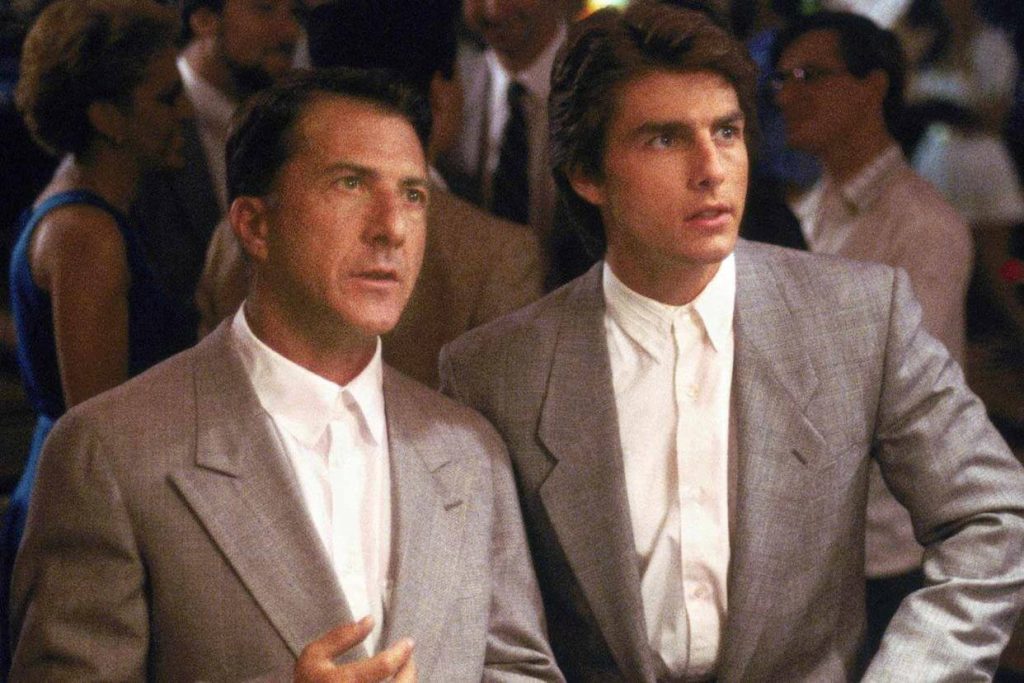
Two years after that memorable encounter, Dustin Hoffman followed through on his spontaneous promise. He sent Cruise the script for Rain Man, a powerful, character-driven story unlike anything Cruise had previously tackled. Directed by Barry Levinson, Rain Man centers on Charlie Babbitt (Cruise), a slick, self-centered car dealer who discovers that his estranged brother Raymond (played by Hoffman) is an autistic savant who has inherited the bulk of their late father’s fortune. The film follows the brothers’ emotionally charged cross-country journey as they learn more about each other—and themselves.
Hoffman’s role as Raymond was complex, tender, and deeply researched. But it was Cruise’s role that served as the emotional arc of the film. Initially brash and impatient, Charlie evolves into a more understanding and compassionate man through his connection with Raymond. This transformation added emotional gravity to the film, elevating it from a simple road story to a deeply human drama. The chemistry between the two actors was undeniable, and their contrasting energies made the bond between Charlie and Raymond feel authentic.
Rain Man was a monumental success. It dominated the 1989 Academy Awards, earning four Oscars, including Best Picture, Best Director (Levinson), Best Original Screenplay, and Best Actor for Hoffman. Although Cruise didn’t win, his performance was widely praised for its maturity and emotional depth. It marked the moment he officially transitioned from teen heartthrob to serious actor, and it all began with a casual restaurant encounter encouraged by his sister.
Acting Lessons from a Master: Hoffman’s Lasting Influence
Working alongside Dustin Hoffman had a profound impact on Tom Cruise’s approach to acting. Hoffman, who was already considered one of the finest actors of his generation, took his craft seriously and shared valuable lessons with Cruise during their time on set. One particular piece of wisdom stood out: Hoffman spoke about his experience on Kramer vs. Kramer and how he adapted his acting to accommodate the young actor who played his son. This adaptability and willingness to collaborate were key takeaways for Cruise.
Cruise internalized this lesson and applied it in future roles. In Interview with the Vampire, he worked closely with a young Kirsten Dunst, ensuring she felt supported in her demanding role. In Jerry Maguire, he shared scenes with child actor Jonathan Lipnicki, creating a nurturing on-set environment that allowed Lipnicki’s charm to shine. These performances reflect a deeper understanding of acting as a collaborative art—something Hoffman exemplified on and off the screen.
Moreover, Hoffman’s dedication to his character in Rain Man taught Cruise about the importance of research and authenticity. Raymond’s portrayal wasn’t just impressive; it was respectful and nuanced. Cruise learned to dive deeper into character study, making it a cornerstone of his future work. As his filmography evolved, from Magnolia to Collateral, it became clear that Cruise wasn’t just chasing box office numbers—he was honing a craft, influenced in part by a mentor who had taken him seriously early on.

Career Transformation: From Action Star to Acting Powerhouse
Before Rain Man, Tom Cruise’s image was largely built around high-energy, charismatic roles that emphasized style over substance. Films like Top Gun and The Color of Money were successful, but they didn’t necessarily showcase the full range of his acting abilities. Rain Man changed that. The film revealed a side of Cruise that audiences—and perhaps even the actor himself—hadn’t fully explored: vulnerability, patience, and emotional complexity.
The impact on his career trajectory was immediate and lasting. Post-Rain Man, Cruise became more selective with roles. He gravitated toward characters with internal conflicts, moral dilemmas, and psychological nuance. His performances in films like Born on the Fourth of July, A Few Good Men, Magnolia, and The Last Samurai were critically acclaimed and demonstrated his growing range. These choices proved that Cruise wasn’t content being just a box office draw—he wanted to be a respected actor.
It’s worth noting that Rain Man didn’t just elevate Cruise’s standing in Hollywood; it gave him credibility in artistic circles that had previously dismissed him. Directors and producers began to see him as someone who could carry more complex narratives. Even in action-heavy franchises like Mission: Impossible, Cruise infused his roles with emotional stakes and depth, a far cry from the one-dimensional heroes of the genre. That transformation owes much to the groundwork laid in Rain Man, and to the collaborative energy shared with Hoffman.
The Ripple Effect: Lessons in Boldness and Timing
The story behind Rain Man is not just about film history—it’s a lesson in life, opportunity, and the power of relationships. Had Tom Cruise not listened to his sister that night in the restaurant, he might never have approached Dustin Hoffman. That single moment, driven by familial encouragement and personal courage, sparked a chain of events that led to one of the most acclaimed films of its time and a transformation in Cruise’s artistic identity.
This tale highlights the unpredictable nature of the entertainment industry, where timing, luck, and initiative often matter as much as talent. It also underscores the importance of surrounding oneself with people who believe in your potential and aren’t afraid to push you out of your comfort zone. Cass Cruise wasn’t just a sister that evening—she was a catalyst. Her insistence helped bridge the gap between two cinematic giants and led to a partnership that touched millions.
For Tom Cruise, the impact of Rain Man is still felt today. It taught him to value authenticity, trust collaboration, and pursue projects that challenge his skills. It also reminded him—and us—that great things often begin with a simple question, a gentle push, or a bold decision. In an industry often defined by ego and spectacle, Rain Man stands as a testament to human connection, both on-screen and behind the scenes. And all of it began with a sister’s belief in her brother’s potential.
From torunstyle
